

You have a date, a rough guest number and a Christmas party idea. Then the questions start: Can everyone reach the venue? Will the menu work for different dietary requirements? Does the programme suit people who do not drink, cannot stand for long or would rather not join a loud competition?
The practical answer is to plan inclusion before you choose the final format. Ask about needs early, keep the answers confidential and build enough flexibility into the event that nobody has to explain themselves publicly.
For more inspiration, review different Christmas party formats and then test each option against the people who will actually attend.
Start with uncertainty, not assumptions
At the beginning, you rarely know the final attendance or every requirement. That is normal. Work with a realistic range instead of waiting for perfect information.
- Estimate a minimum and maximum number of guests.
- Note which teams, offices or shift patterns are represented.
- Ask whether guests may bring a partner or whether the event is employees-only.
- Set a date by which attendance and individual requirements must be confirmed.
- Keep a small contingency in the budget for transport, menu changes or additional support.
Do not try to guess who may need an adjustment. A mixed team includes different circumstances that are not always visible to colleagues or organisers.
Collect requirements privately and neutrally
Your invitation or RSVP form should make it easy to share practical needs without asking people to disclose personal information. Use a neutral question such as: “What would help you take part comfortably?”
Offer clear answer fields for:
- Dietary requirements, allergies and religious or belief-related food needs.
- Step-free access, accessible toilets, seating or reduced walking distances.
- Hearing, visual or communication support.
- Quiet space or a lower-stimulation alternative.
- Travel, finish-time or childcare constraints.
- Whether the person needs a named contact before or during the event.
Tell people who will handle the information, how it will be used and when it should be deleted according to your organisation’s retention approach. Share only the practical requirement with the venue or caterer. For example, the caterer needs to know that a guest requires a nut-free meal; they do not need to know the person’s medical history.
Religious and belief-related dietary needs should be considered when food is provided at work events. Acas also recommends considering requests connected with fasting and other religious needs. This is practical planning guidance, not a substitute for advice on a specific legal situation. Acas guidance on preventing religion or belief discrimination explains the wider workplace context.
Choose a format that gives people options
A successful Christmas party does not require everyone to do the same thing at the same time. A good format creates shared moments but also allows people to join in at their own pace.
| Format | Why it can work | Check before booking |
|---|---|---|
| Seated meal with optional programme | Predictable, conversational and easier to adapt for different mobility levels. | Menu labelling, seating plan, noise level and an alternative to speeches or games. |
| Indoor winter market or food-station event | People can move between offers and choose how long to stay in each area. | Seating density, accessible routes, queue times and suitable non-alcoholic drinks. |
| Creative workshop followed by food | A shared activity gives conversation a focus without requiring physical competition. | Work-surface height, materials, lighting, instructions and a seated alternative. |
| Short daytime celebration | More workable for public transport, caring responsibilities and employees who do not want a late evening. | Travel connections, shift coverage and whether the timing conflicts with religious observance. |
| Hybrid or distributed celebration | Useful when teams are spread across locations or travel is difficult. | Equal access to food, facilitation, technology and a meaningful shared activity. |
At short notice, a seated or semi-flexible indoor format is often easier to make inclusive than a tightly timed outdoor activity. That is not a rule. It is a reminder to match the programme to the information you have actually confirmed.
Check the venue from the guest’s point of view
Arrival and movement
- Can guests arrive without stairs, steep surfaces or long walking routes?
- Is there an accessible entrance rather than only an accessible back door?
- Are lifts, toilets, cloakrooms and dining areas easy to find?
- Are there enough seats throughout the event, not only at the meal?
- Can a wheelchair user or someone with limited mobility move between key areas?
Sound, light and communication
- Can announcements be heard without excessive background noise?
- Is the lighting comfortable and are signs easy to read?
- Will activities be explained in writing as well as verbally?
- Can the programme work for colleagues with different language levels?
Quiet alternatives
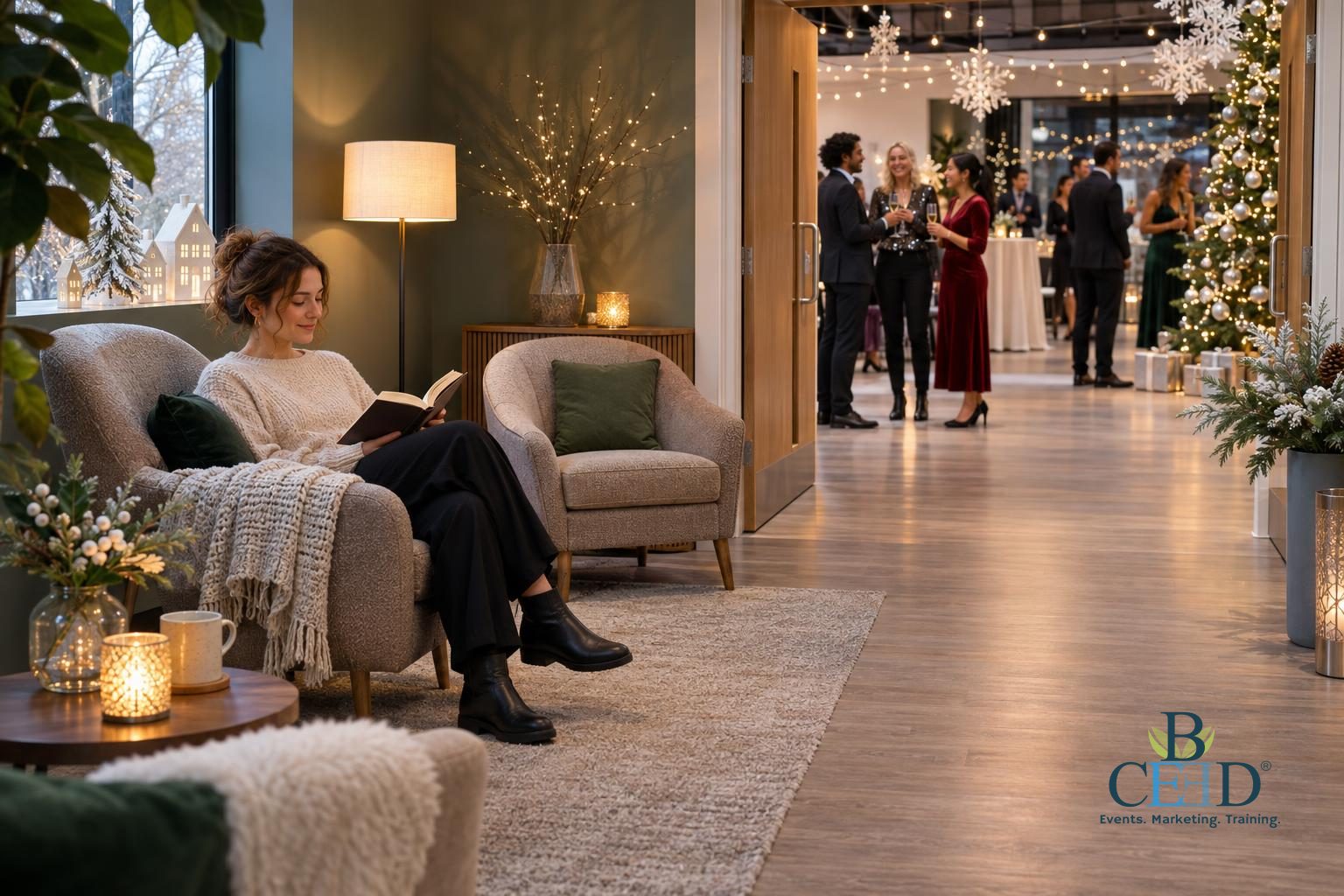
Provide a calm area away from the loudest part of the event. It does not need to be labelled as a special room. A separate lounge, a lightly programmed seating area or permission to step outside can be enough. Make sure people know where it is before the event begins.
Make food and drinks genuinely inclusive
Ask the caterer for a complete list of ingredients and allergens, not just broad labels such as “vegetarian options available”. Confirm how meals are prepared and served so that suitable food is not contaminated or mixed up during service.

A workable catering brief should cover:
- Vegetarian and vegan choices that are substantial rather than decorative side dishes.
- Allergy management and clearly identified ingredients.
- Religious or belief-related requirements, including halal, kosher or fasting-related needs where requested.
- Food that can be eaten comfortably while seated or standing.
- Alcohol-free drinks that are visible, varied and included in the main offer.
- Hot and cold alternatives where the event runs across a long period.
Do not make alcohol the organising principle of the evening. A good non-alcoholic offer should be available from arrival through to the final programme, not added as an afterthought.
Design activities with more than one way to participate
Before booking an activity, ask what participation actually involves. Does it require speed, physical strength, loud performance, close contact, alcohol or public improvisation?
More flexible options include:
- Creative workshops where people can work individually or in small groups.
- Food-based formats with clearly explained alternatives.
- Light puzzle or quiz activities with written and verbal instructions.
- Storytelling, live entertainment or a short guided performance.
- Optional team challenges where watching, advising or documenting also counts as participation.
Explain that joining an activity is invited, not compulsory. Avoid putting people on the spot with public reasons for opting out. If an activity has winners, keep the prize and competitive element light.
Plan timing, transport and childcare realistically
An event can be accessible at the venue and still be difficult to attend because of its timing. Consider the whole journey, not only the official programme.
- Choose a start and finish time that works with public transport and the company’s shift patterns.
- Publish the expected finish time clearly. “Open end” can be stressful for people arranging care or transport.
- Provide practical travel information, including the nearest station, parking and any shuttle arrangements.
- Ask whether colleagues need to leave early and make that socially easy.
- Consider a daytime or early-evening format when childcare responsibilities are common.
- Build in enough time for arrivals, coat storage, food service and transfers between locations.
If the event includes alcohol, communicate that no one is expected to drink and do not make late-night continuation part of the unofficial programme.
Use a simple inclusion checklist
Before you confirm the booking, work through this list with the event team and venue.
- Invitation: purpose, date, timing, location, finish time and RSVP deadline are clear.
- Needs collection: requirements can be shared privately and a named person owns the follow-up.
- Venue: arrival, toilets, seating, movement, sound and quiet space have been checked.
- Catering: requirements, allergens, religious needs and alcohol-free choices are confirmed in writing.
- Programme: no activity depends on drinking, physical ability or public performance.
- Travel: public transport, parking, shuttle and early-departure information are available.
- Communication: the final message explains what guests can expect and who to contact.
- Contingency: there is a plan for late transport, weather, supplier changes or a lower-than-expected turnout.
Ask for feedback without turning inclusion into a survey exercise
Send a short anonymous feedback form after the event. Ask questions that lead to useful changes:
- Could you take part comfortably from arrival to departure?
- Was any information missing before the event?
- Did the food and drinks offer work for you?
- Were there enough ways to participate or take a break?
- What should we keep, change or avoid next time?
Look for patterns rather than trying to identify individual respondents. Share two or three concrete improvements with the team so that feedback leads to action.
Next step: turn the checklist into a brief
Write down the expected attendance range, preferred timing, travel limits, programme boundaries, catering requirements and accessibility arrangements. Then ask the venue or event agency to respond against those criteria instead of sending a generic proposal.
Our guide to briefing a corporate event agency can help you structure that first enquiry.
That gives you a clearer comparison and makes it easier to plan a Christmas party that feels welcoming in practice, not only in the invitation.